
For several months, at Covenant Associates, we have been applying artificial intelligence in real conditions to IT and Business Planning functions. Here is where we stand, and where we are heading.
01What already exists
Documenting, at scale
The first workstream is the functional and technical documentation of the fleet of planning models (e.g. Anaplan): mapping of indicators and data flows, thematic sheets, all delivered in three complementary formats (shareable document, versioned source and interactive model browser).
This documentary completeness is no longer a one-off, ad hoc project effort. It becomes a background task, a recurring and automatic activity, produced and kept up to date continuously by agents. Done manually, this work would take weeks of scarce expertise.
Auditing, then acting
Documentation serves as the foundation for a second step: audit. On targeted models, agents detect unused objects, structural anomalies and architectural drift, then propose concrete recommendations.
The gains are tangible. In some cases, the exercise can halve the footprint of the models, which defers upgrade investments. It also uncovers unused objects or objects that do not follow conventions, as well as redundant or contradictory flows, for better readability and easier maintenance for the teams that inherit the models.
Documentation and audit thus form a broad, self-updating base of context. What used to take hours of manual analysis, and the availability of multiple stakeholders (architect, data, business, builder…), is now obtained in an automated and instantaneous way.
Shared data: an asset that grows stronger project after project
Documentation and audit do not stay frozen in static deliverables. They are delivered through interactive web apps that offer a navigable view of how data is inherited and how it flows: from one module to another, from one model to another, up to the upstream and downstream flows.
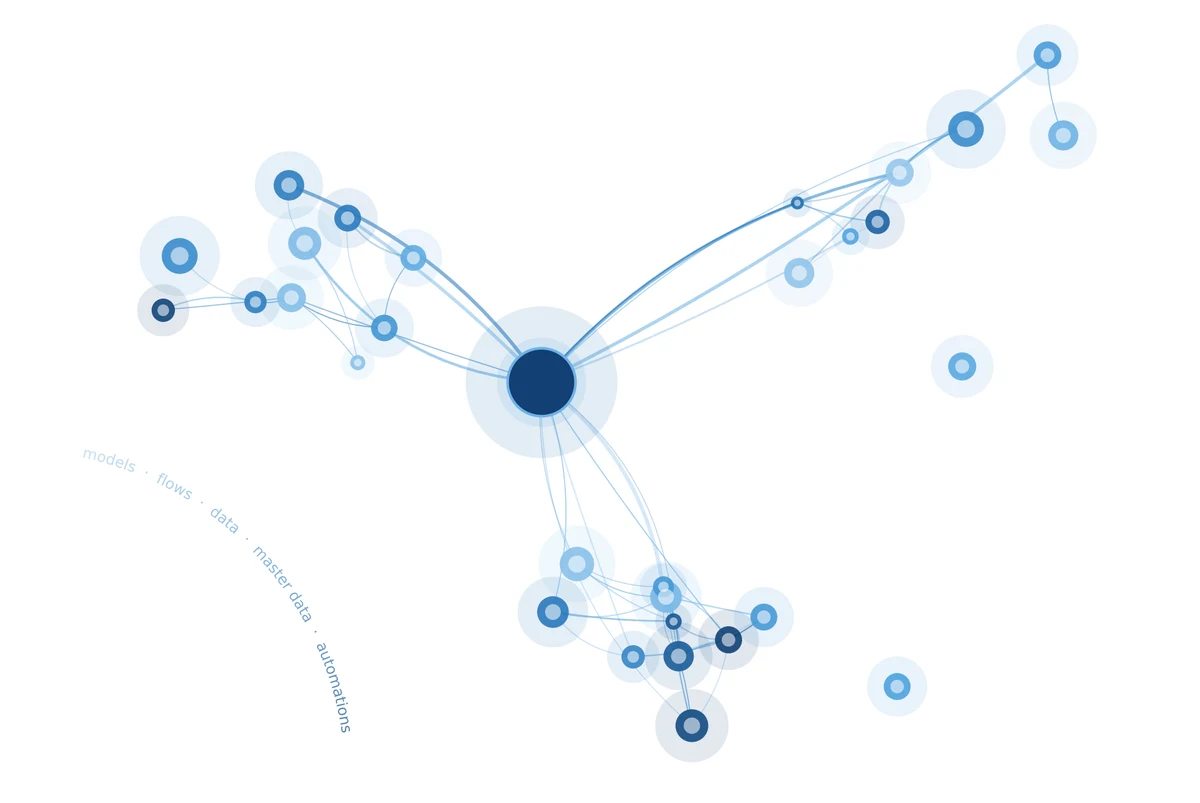
This continuous view of the flows makes it possible to streamline them and makes it easier to add new use cases to the environment. Each new agent builds on a map that is already alive, rather than starting from scratch.
Standardizing business specifications
We apply a methodology to frame business specifications, with a common nomenclature to describe a need, a management case or a calculation rule. This nomenclature brings out specification patterns: recurring shapes that are found from one project to the next.
Once these patterns are identified, writing a specification becomes a repeatable task. It builds on proven templates rather than a blank page, it is easier to approach for those who are not familiar with the subject, and it is easier for an agent to use, since an agent can read the nomenclature and make use of it.
Scoping and writing phases go faster, with a more consistent level of quality and completeness from one project to the next.
This is where our experience makes the difference. Knowing what to describe, how to structure it and at what level of detail makes it possible to use AI intelligently. That is Covenant’s added value.
Agents that move from audit to automating part of the business function
Automated model audit and the standardization of business specifications serve as the foundation for many other uses. Agents leave the ground of static, after-the-fact audit to become actors in the automation of business processes. The prerequisite for doing this effectively is the ability to audit and to organize in a nomenclature, automatically and exhaustively.
In this part on what already exists, two key examples show how agents support the business.
Core business processes, such as budget framing or simulation. AI puts into the hands of business users interfaces in which they enter their assumptions and get a quick answer, or a trajectory result, without having to rerun their model.
Ad hoc reporting in natural language. It goes well beyond generating a report on request. Teams dedicated to monitoring entities or teams can produce, for their clients, much more specific and better-tailored reports, including taking unstructured data into account, such as comments. Once proven, a report can be made permanent: the chosen structure then updates automatically from one financial year to the next. An example of use: justifying, for mutual groups, an audit trail of allocated costs.
Once the model and its context are made readable by machines, we can build well beyond documentation.
Moving beyond the isolated model
These results come from connecting AI with its context.
We build on the native structures of the tools and connect them to the client’s business context and processes: what happens upstream (source data, business trade-offs) and downstream (reporting, decisions, actions). End-to-end continuity, across the whole value chain, requires one prerequisite: an integrated AI platform. With it, we move from a one-off exercise to an ecosystem of agents able to answer cross-cutting questions, and not only queries on an isolated module.
03What comes next
Once this integrated AI platform is in place, its connection with the vendors’ solutions needs to be strengthened, and business teams need to be empowered to use it. Yet most vendors of planning or ERP solutions have not yet published their protocol for connecting to models (MCP). Anaplan, for example, is preparing to publish its own MCP: this is a turning point that we are anticipating today. But our conviction goes beyond this single milestone: the expertise we are building in context generation and in structuring knowledge and use cases is largely reusable and transferable, whichever AI model the client chooses. The central issue is not the underlying technology, but the proper structuring of use cases, and this is precisely where Covenant positions itself.
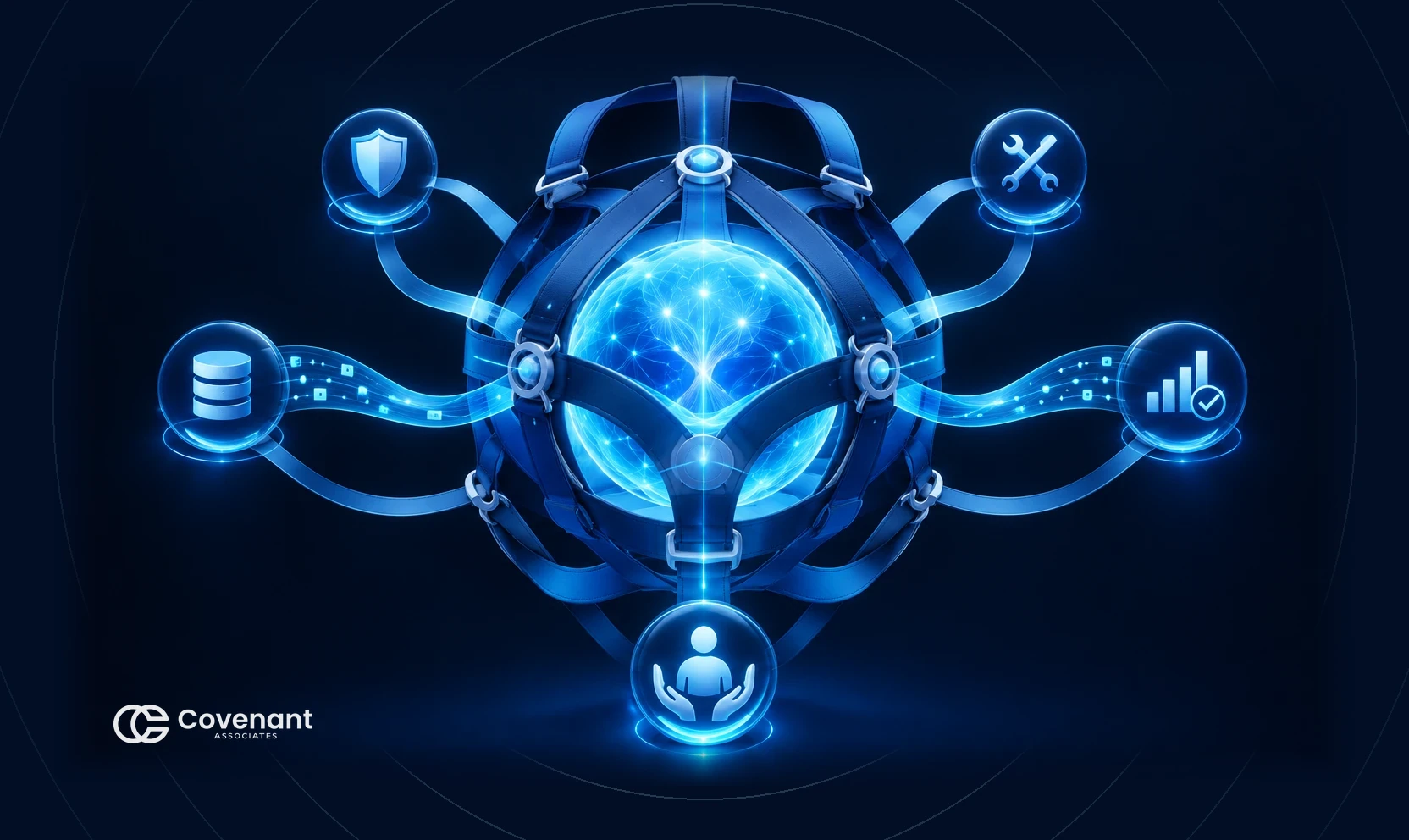
The day this building block is available, companies that have already structured their context, their connectors and their agents will have a head start. That is why we are investing now in the “AI harness”: the platform that hosts the agents, the connectors that feed them (project management, living documentation, data platform), and how they connect with the tools’ future native capabilities.
Two assets already prepare us for it: our detailed knowledge of the business context and our specification standards, presented above. They give us a head start in context engineering: knowing what the model needs to see, and how to organize it so that it succeeds. With Anaplan’s MCP, for example, this work will build on Anaplan’s CoModeler as soon as the native connection is available.
Beyond the tools, business teams must be able to create their own agents by themselves, across silos. Once they are empowered, as an example, we could imagine a management controller and an accountant co-building a reconciliation or provisioning agent.
04Our convictions
Four convictions guide our approach to AI for business planning functions.
Proprietary context makes the difference. AI models change and get replaced. What remains is the company’s context: its models, its flows, its business rules, its specifications.
The foundation comes before the agents. Documenting, auditing and standardizing automatically and exhaustively then makes it possible to automate part of the business processes.
Business teams must be empowered. AI delivers value when business teams use it directly, to test assumptions, monitor their entities and produce their own reports.
We must prepare before the standards arrive. An integrated AI platform, connectors and agents structured today make it possible to take advantage of vendors’ protocols as soon as they arrive.
This is the approach, tooled and cumulative, that we deploy with our clients.